The Enduring Legacy of C.S. Lewis Part 1: Dr. David Downing & Rachel Dodge
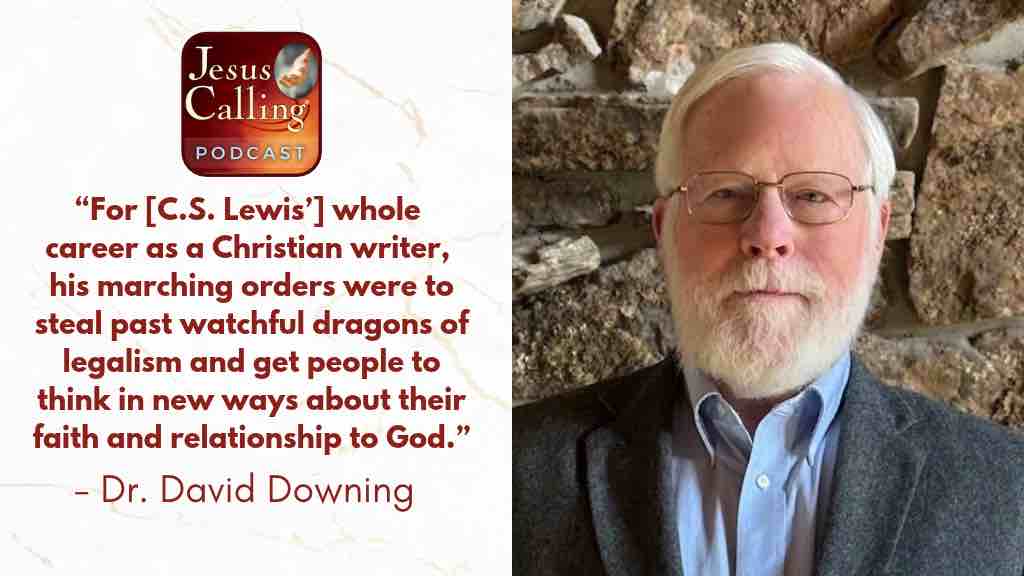
Dr. David Downing: What strikes me is how people got introduced to C. S. Lewis and how he influenced their spiritual journey. Some writers have one great book, and everybody refers to that one book. But with Lewis, there’s at least a dozen books that people say was their starting point.
The Enduring Legacy of C.S. Lewis Part 1: Dr. David Downing & Rachel Dodge – Episode #539
Narrator: Welcome to the Jesus Calling Podcast. This week, we’re exploring, as part of a two-part series, the legacy and works of C.S. Lewis and how he has helped make Christianity accessible to people who are searching. First, we talk with C.S. Lewis scholar Dr. David Downing who recounts how Lewis’ writing helped him work through difficult questions about Christianity. Then, author Rachel Dodge discusses finding lessons about Jesus in The Chronicles of Narnia and how it helped her face fear with courage.
Let’s begin with Dr. Downing.
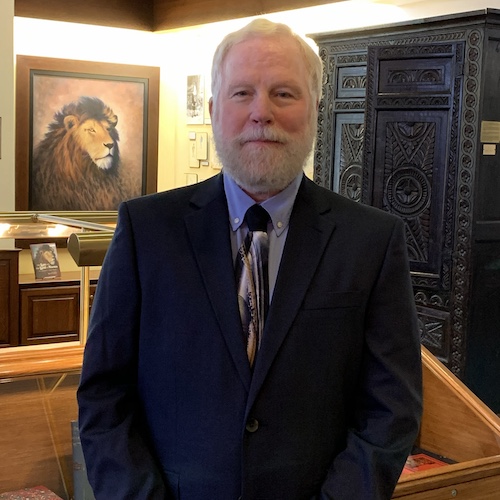
Dr. David Downing: My name is David C. Downing. I’m a retired professor of English. I grew up in Colorado. I went to school in California at Westmont College and then UCLA. I have taught all around the country. Right now, I’m retired, but I’m teaching a C.S. Lewis course at Christian College University in Denver.
How C.S. Lewis Reawakened His Spiritual Imagination
I grew up in a Christian home, very conservative—one would now say fundamentalist—and I was struggling with a lot of questions. My brother and I called them not the seven deadly sins, but the seven deadly questions. The problem of evil: how could a good God allow for so much suffering and injustice? The discrepancies in Scripture: are we sure this is historically accurate? Why are there any contradictions or discrepancies? The problem of the noble heathen: what do we do with tribes and peoples that never had a chance to hear the Gospel? So I had my seven deadly questions. I went off to Westmont College in Santa Barbara, and a professor assigned Perelandra. That was my portal into C.S. Lewis’s writings. There’s a good book called Mere Christians, and it’s essays by people on how they got introduced to C. S. Lewis and how he influenced their spiritual journey. And what strikes me is how many different portals there are. Some writers have one great book, but everybody refers to that one book. But with Lewis, there are at least a dozen books that people say was their starting point. For me, it was Perelandra.
What I liked about Perelandra was it caused you to make all things new in terms of faith. He was very aware that a lot of people had very stale theological conceptions and images, and he wanted to re-energize their imagination. When his hero, Ransom, goes to Malacandra, he said he didn’t see any messengers. He only saw footsteps of light, like the dance of sunlight on a lake. So I was walking home from the library at school to my dormitory and the moonlight was filtering through the leaves of the trees, and I felt like I was surrounded by eldils or angels. So for me, the starting point was re-awakening my spiritual imagination, getting away from the cliches and the stereotypes of Scripture into new, more invigorating ways to think about spiritual realities.
“[C.S. Lewis] was very aware that a lot of people had very stale theological conceptions and images, and he wanted to re-energize their imagination. For me, the starting point was getting away from the clichés and the stereotypes of Scripture into new, more invigorating ways to think about spiritual realities.” – Dr. David Downing
I wrote a paper on how he often ministers the imagination as a way to sway the intellect, rather than depending upon purely rational arguments. The professor liked my paper so much, he submitted it to Christianity Today, where it was published in the seventies. Later on, when I struggled in my personal faith, I’d go back and read my own article to be encouraged in my faith. So that was the starting point.
As to how Lewis has influenced my own thinking and my own spiritual journey, I would go back again to the idea of these perpetual questions I had. In general, I had a lot of pat answers that I received from my upbringing and my church growing up that were not emotionally satisfying nor intellectually rigorous. When I started reading Lewis, someone asked him about the problem of the noble heathen or the virtuous unbelievers, they called them. And he pointed them to the parable of the sheep and the goats, where Jesus says, “There are those who say ‘I did all these things in Your name.’” And Jesus says, “I never knew you. [Matthew 7:22-23]” And then he says to others, “If you’ve done this to the least of these, you’ve done that to Me. You visited Me in prison. You fed Me. You clothed Me.” And Lewis loved that passage because it didn’t make the idea of salvation versus condemnation so cut and dry. It allowed you to relax on that particular question. There’s not going to be anyone who deserves to be in heaven who will end up in hell. So I think Lewis has helped me find more intellectually compelling answers and more intellectually satisfying answers. He also has awakened imagination. I’ve read The Chronicles of Narnia at least twenty times. And they always, for me, just re-energize Biblical principles in new ways. They take what had been the old wineskins of spiritual clichés and put new wine into them.
“I’ve read The Chronicles of Narnia at least twenty times. And they always, for me, just re-energize Biblical principles in new ways. They take what had been the old wineskins of spiritual clichés and put new wine into them.” – Dr. David Downing
Pursuing Theological Questions With a “Cheerful Curiosity”
My reading of Lewis, I’m always so impressed by how much he blends psychology and spirituality. When I was growing up, you were supposed to sing songs like “I’ve got this joy, joy, joy, down in my heart.” And he keeps me singing a happy song. It almost made Christian faith sound like a wonderful kind of toothpaste. It was this brand that would bring happiness to life. And I was not a naturally cheerful kid. So I always felt depressed by the fact that I didn’t feel excited about my faith. I didn’t feel the glory of the Lord. And Lewis was really helpful to me in stressing over and over again, “Your faith is not a feeling. Faith is a commitment of the will and affirmation of the intellect.” And he said over and over in his letters, “Don’t worry about feeling the presence of God. He’s often there when you least feel Him.” Or, “Don’t count on your feelings.” We all have troughs and peaks, and to think that God has left you because you’re in a personal trough is to misunderstand the nature of His presence.
“Lewis was really helpful to me in stressing over and over again, ‘Your faith is not a feeling. Faith is a commitment of the will and affirmation of the intellect.’ And he said over and over in his letters, ‘Don’t worry about feeling the presence of God. He’s often there when you least feel Him.’ Or, ‘Don’t count on your feelings.’ We all have troughs and peaks, and to think that God has left you because you’re in a personal trough is to misunderstand the nature of His presence.” – Dr. David Downing
He was also very helpful to me, teaching me to hold certain issues loosely. When I was young, I felt like free will and determinism—I’ve got to decide what’s up with that. Is it free will, is it determinism? How can the two be both true, because they’re contradictory? And Lewis said, “Well, if God is outside of time, His view of free will and determinism is going to be very different. We feel that way because we’re inside time.” He compared it to physics, trying to figure out what exactly atomic quanta are. Are they particles? Are they waves? We wish we could say, “Oh, it’s this one or it’s that one,” but we have to live with the fact that it’s both. And Lewis said in one letter, “If we can’t even ascertain the nature of the physical reality, how much more so would we not be able to ascertain the nature of its Creator?” So a number of questions I just learned to hold more loosely. I don’t have this what he called frantic desire, to have all these things spelled out for me. He said, “Often you should pursue theological issues with a cheerful curiosity rather than a frantic desire to solve the problem.” So I believe he’s helped me in taking an approach which is more intellectually comfortable, and emotionally comfortable, than that kind of drive to have an answer, even if it’s too simple of an answer.
Why C.S. Lewis Made Time for Strangers
Lewis as a serious writer felt obligated to answer questions from correspondents. He felt as a Christian writer, it was part of his duty to answer letters, even from strangers, and even personal letters about things they were struggling with. And he wrote at one place, he said, “I’m very sorry to hear you say you want to follow me. I want you to follow Jesus.” In another letter, he says, “This is just my guess. I’m not an inspired writer, that is very much not the case.” So he was having to deal with this halo effect of how well he articulated the Christian faith. And I started getting very personal letters from people who are struggling with depression, or feeling they’ve lost their faith, or they’ve committed the unpardonable sin. I find myself in the unenviable position of trying to answer as C.S. Lewis might have answered. So it’s interesting to be a Lewis scholar, as opposed to a strict literary critic. You get both the benefits and some of the responsibilities that go with readers who really want to interact about not only Lewis’s faith and my faith, but their own faith.
“It’s interesting to be a Lewis scholar, as opposed to a strict literary critic. You get both the benefits and some of the responsibilities that go with readers who really want to interact about not only Lewis’s faith and my faith, but their own faith.” – Dr. David Downing

His friend Walter Hooper, and later his private secretary, said, “C.S. Lewis was the most thoroughly converted man I ever met. He made every effort to make all of his daily activities a part of his Christian witness.” He had a good friend named Arthur Greeves who would write him long letters about theology. Finally, Lewis wrote back and said, “I’d like to continue this topic, but I get up to thirty-five letters a day from people, many of whom are in genuine anguish over tragedy in their life or struggles with faith.” And he said, “I really need to devote more time to writing to these strangers who write to me.” So I think it’s very typical of his attitude that he considered his writing a ministry, but also his personal correspondence a ministry. One letter he says, “I’ve been writing letters to strangers for nine hours so far.” And another one says, “This is my thirty-fifth letter of the day.” These are all handwritten letters, but his feeling was it wasn’t just a courtesy, it was a part of his Christian ministry to correspond. Some of them he wrote so often—there’s an entire slender book of his letters to a Catholic priest in Italy. They’re all in Latin on both sides. The Italian priest didn’t speak English and Lewis didn’t speak Italian, so they corresponded for several years in Latin.
That’s kind of his marching orders for his whole career as a Christian writer, is to steal past watchful dragons of legalism or stereotyping and get people to really think in new ways about their faith and their relationship to God.
“That’s kind of [C.S. Lewis’s] marching orders for his whole career as a Christian writer, is to steal past watchful dragons of legalism or stereotyping and get people to really think in new ways about their faith and their relationship to God.” – Dr. David Downing
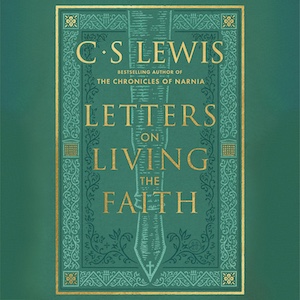
Narrator: To learn more about Dr. David Downing, please be sure to check out his latest project, Letters on Living the Faith, a collection of excerpts from C.S. Lewis’s letters, available at your favorite retailer.
Stay tuned to our conversation with Rachel Dodge after a brief message.
Ring in the Holidays with Jesus Calling Seasonal Products
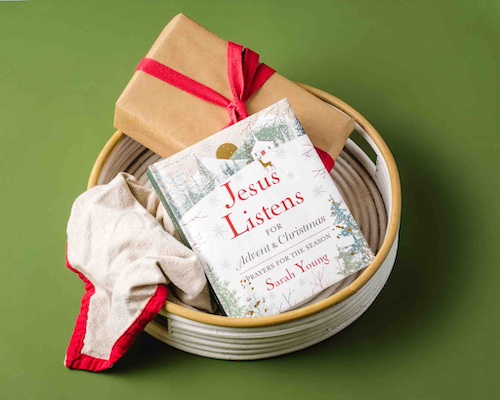
In a world that moves so fast, Christmas can feel overwhelming. But what if this season could bring you deeper peace?
Discover the Jesus Calling line of Christmas books—devotionals for all ages and stages that guide you to the heart of the season. For adults, check out the beautifully illustrated Jesus Listens for Advent and Christmas, Jesus Calling for Christmas, and Jesus Listens: Prayers for Every Season. The children in your life will love opening Jesus Calling Advent & Christmas Prayers, Jesus Calling: The Story of Christmas, and the brand-new, seasonally illustrated Jesus Listens for Christmas.
Whether you’re seeking personal renewal or the perfect meaningful gift, these books remind us that Christmas isn’t about the rush—it’s about the peace that comes from God’s love. Give the gift of quiet moments, spiritual comfort, and the true joy of Christmas.
Find Jesus Calling Christmas books at your local bookstore or visit www.amazon.com/jesuscalling.
Our next guest is Rachel Dodge, a devotional author who grew up reading out loud in a house bursting with books, and who felt inspired in a new way while standing in C.S. Lewis’s study in Oxford. She shares how the character of Aslan from The Chronicles of Narnia gives her a picture of Jesus and why she believes we never face fear alone.
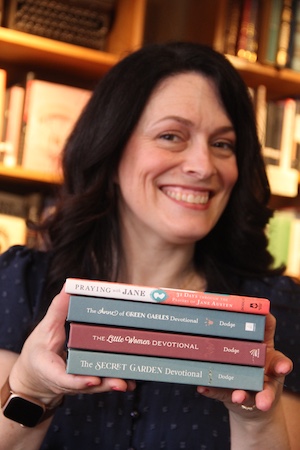
Rachel Dodge: I’m Rachel Dodge, and I am a devotional author. I have written a lot of different devotional books based on classic literature.
I grew up in a house filled with books. It was a small house bursting at the seams with books, and my family read all the time. So I read books, and then we read out loud to each other, and that just formed the foundation of my life. I love words and stories, and it created a whole world for me outside of my natural world, which was so fun to be able to go into that world and inhabit that world.
And then as I’ve had children, it’s kind of been the same. I loved to read with my kids. When they were growing up, I read out loud all the time to them. I have found in my home, and with my kids, that reading out loud has been one of the best ways we connect and one of those bonding experiences as a family.
Writing Devotionals from Classic Literature
Every story I read, I kind of can see these little lessons. And then as I grew in my faith over the years, I started to see what I call little Jesus moments or God glimpses in different literature. And I’m always looking for themes. I’m also looking for how it could apply to my life. So I think part of it is that I just kind of think that way. It’s kind of how my brain works.
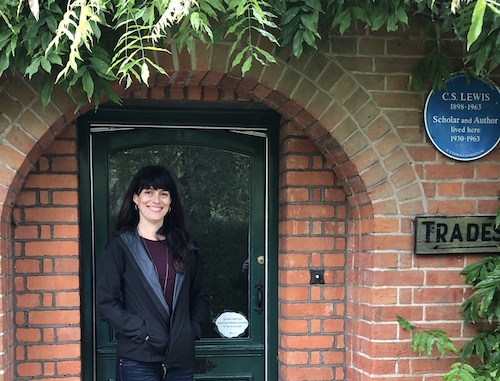
I was actually standing in C.S. Lewis’s home in Oxford—it’s called The Kilns—in 2019. And I just took a tour with a small tour group with my family, and never a devotional book on my mind other than, Oh, wouldn’t that be cool, maybe? I don’t know. But as I stood there in his study and the tour guide explained that that was where he wrote The Chronicles of Narnia, I can’t explain it except I felt the Lord grab my heart. And by the time I left, I looked at my husband and I said, “I think I’m supposed to write a devotional book.” We both talk about it all the time.
And it took a long time for that to come to pass. But I want to encourage the listener that sometimes God puts something incredible on our hearts, something that sounds impossible, something that we think, Surely not me, Lord, and then He brings it about. He does something cool and He opens doors. And I feel like that’s part of living like a Narnian is, Okay, Lord, you’re going to open this wardrobe door and I’m going to step through and see what happens. And I know you’re going to be there. You’re going to meet me.
“I want to encourage the listener that sometimes God puts something incredible on our hearts, something that sounds impossible, something that we think, Surely not me, Lord, and then He brings it about. He does something cool and He opens doors.” – Rachel Dodge
I mean, growing up reading those books, reading them over and over with my children over the years, and even as an adult, I just love reading them. And so to be able to take the rich spiritual lessons and pictures and poignant moments that are throughout all of those Narnia books was just an absolute joy. It almost comes naturally, but also as I’m writing, the Holy Spirit shows me stuff I would have never thought of. It’s always like these interesting little twists that I go, Oh wow, I never noticed that one.
My newest devotional is called The Chronicles of Narnia Devotional, and it’s a fifty day devotional based on C.S. Lewis’ beloved series, all seven books. It has reflections written by me. Each entry in the book, all fifty entries, include an excerpt of a favorite moment throughout the Narnian books. And then, we’ll have key Bible verses, personal application, and a reflection just to help us to take those beautiful stories and kind of make them our own in terms of our faith. That’s how I take the literature world and the faith world, I feel like I get to put my hands together and take two of my favorite things and blend the two.
Learning to Live Like a Narnian
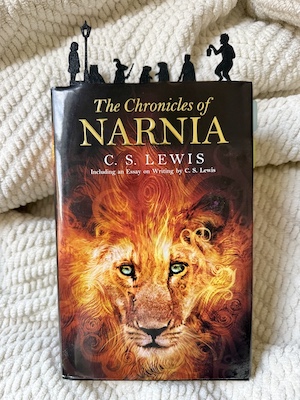
I find myself really inspired by the characters in Narnia because they do things that are really outside of their comfort zone. They become brave when they’re in Narnia. There’s something about even the air in Narnia and at times when they lose courage, Aslan will breathe on someone and courage comes back into them.
I feel like God is calling us and continues to call us as Christians to be brave and to overcome fear and to do valiant deeds. It’s not just for the knights in shining armor or the first responder. Every day we can be a hero. We can be brave. We can overcome our fears and be really courageous.
“I feel like God is calling us and continues to call us as Christians to be brave and to overcome fear and to do valiant deeds.” – Rachel Dodge
I would say for a lot of readers, probably myself included, that just the character of Aslan is very meaningful, and I think it gives us this illustration or picture of how Jesus might be or how He appears in Scripture. So I always resonate with all of those one-on-one personal moments that characters have with Aslan in the books. When I was writing the devotional, there were a lot of times where I really clued in on those, and kind of zoomed in on maybe a moment between Lucy and Aslan when He says, “Courage, dear heart.” Or when Aslan lays down his life willingly to replace Edmund who has been named a traitor, and he comes to life. That one’s really obvious, but those scenes are so poignant and so beautiful and so touching that it really grabs you. Like I said earlier, story brings certain things to life even more for us, and we kind of feel what the characters are feeling.
It’s a group project, so to speak, in a lot of the scenes in Narnia where there’s something really bad happening. Other people are coming, and a lot of times Aslan comes bounding in, and even if He’s not physically present, they know He’s present, or someone might hear a whisper or later say, “Oh, I knew it was Aslan.” And so, as I was writing the devotional, I really wanted readers to pick up on those things in the story and then apply that and realize it.
I really feel like when we are talking about these themes of fear and faith and doubt and forgiveness, we can look at the Narnia books and we can see all of that, the whole human experience. And then we see victory and we see bravery and we see heroics. And I think that inspires us to want to live… I want to live like a Narnian in my everyday life as a wife and a mom. I still want to be doing these acts of valor. And that just might be that I’m worried about something, and my act of bravery is to say, “Lord, I trust You with that, and I’m going to get back to work and stop worrying about it.” That might be my little act of bravery.
“I really feel like when we are talking about these themes of fear and faith and doubt and forgiveness, we can look at the Narnia books and we can see all of that, the whole human experience. And then we see victory and we see bravery and we see heroics.” – Rachel Dodge
Relying on Each Other Through Doubt and Discouragement
I think it’s really important to connect with God daily on a personal level, because one, that’s how we get to know Him better. I know it’s kind of cliché to say, but if you have a friend and you never talk to them, you’re probably going to grow apart, grow distant. You might not know them as well as you used to. I think of moving away from a lot of friends and family four or five years ago. I need to keep in touch with my family members, or I will start to just be distant from them and not know what’s going on in their daily lives.
So I think that’s part of why a daily connection with the Lord is important and having your own quiet times and devotions. At the bookstore where I work, we carry Jesus Calling and then there are several other different offshoots from it. That is something a lot of people come in looking for—Jesus Calling for a specific audience or just the original. And so we have those right up front in our bookstore because it’s so popular.
My mother-in-law actually gave me a copy probably ten years ago. I always have one or two devotions with my Bible and my journal, so sometimes I use a devotional as kind of a warmup when I’m not really awake yet and not quite ready to jump right into the Old Testament or whatever I’m reading. Other times, it’s just such a stressful or hard day that picking up a devotional book really helps me to connect with the Lord because it’s usually like one specific verse, one specific theme.
I think that personal connection is our lifeline. It’s just essential. We are going to doubt, we’re going to feel discouraged, we’re going to have fear, we are going to have all of those emotions, we’re going to need to forgive someone who has wronged us or our family member. And, we on our own probably can’t overcome some of that. There’s always others that are called to help. I’m going through all this, but I know I’m not alone. There’s other people, there’s other Narnians around, there’s other Christians. I can ask for prayer. I can ask for help. I can always call on God. He is there. I might not see Him tangibly. He’s not going to be a lion that bounds in necessarily like an actual lion.
“I know I’m not alone. There’s other people, there’s other Narnians around, there’s other Christians. I can ask for prayer. I can ask for help. I can always call on God. He is there.” – Rachel Dodge
However, God is very loving, but also, very protective. Jesus is the Lion of Judah. He’s like the Lion and the Lamb, so He’s gentle. He cares for us, He comforts us when we’re fearful, when we are sad, when we’re grieving. God loves us so much, and we can call on Him when we’re afraid. He will comfort us and protect us and help us.
Jesus Calling, October 2nd:
Never take for granted My intimate nearness. Marvel at the wonder of My continual Presence with you. Even the most ardent human lover cannot be with you always. Nor can another person know the intimacies of your heart, mind, and spirit. I know everything about you—even the number of hairs on your head. You don’t need to work at revealing yourself to Me.
Many people spend a lifetime or a small fortune searching for someone who understands them. Yet I am freely available to all who call upon My Name, who open their hearts to receive Me as Savior. This simple act of faith is the beginning of a lifelong love story. I, the Lover of your soul, understand you perfectly and love you eternally.
Narrator: To learn more about Rachel Dodge, visit www.RachelDodge.com, and be sure to check out her new book, The Chronicles of Narnia Devotional, at your favorite retailer.
If you’d like to hear more stories about finding faith through our questions and doubts, check out our interview with Cole Arthur Riley.
Next week: Tim Gresham

Next time on the Jesus Calling Podcast, as we continue celebrating C.S. Lewis’s legacy, we’ll hear from his step-grandson, Tim Gresham, who calls him Jack. Tim shares what life was like growing up in C.S. Lewis’s legacy, and how his influence would eventually lead Tim’s family back to a relationship with God.
Tim Gresham: Ultimately, Jack showed a skeptical, modern world that Christian faith can make sense to the intellect. It can eliminate beauty and it can move the imagination all at the same time. The rich spiritual lessons for Narnia are ones of redemption, ones of self-sacrificial service, the resurrection, the forgiveness of sins, transformation, faith, courage, humility, truth, awe, longing, hope, and beauty—it’s all there. It’s all in the Narnia stories.